Kipwise
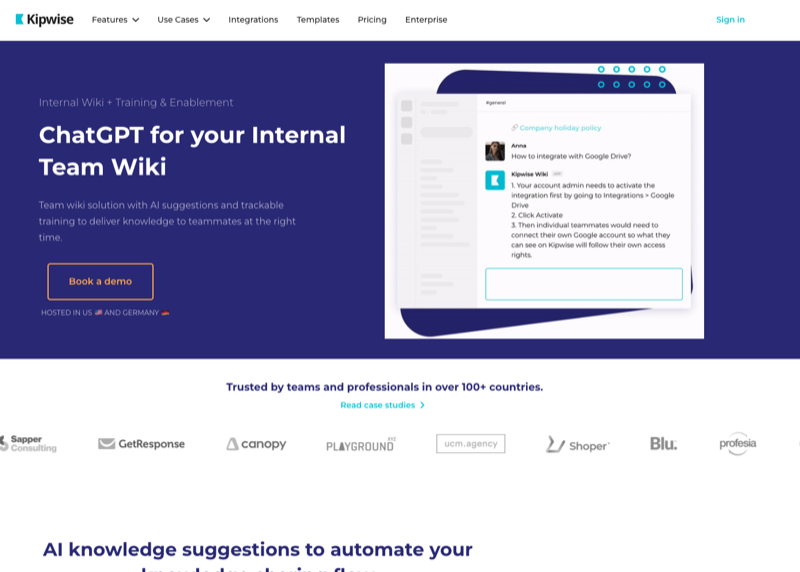
AI-powered knowledge management for teams. Think of it as ChatGPT for your internal wiki: it centralizes what your team knows and surfaces the right answer inside Slack, the browser, and search, so people stop asking the same questions twice. We built it, we run it, and it is used by teams in 100+ countries.
What it is
Kipwise is an internal wiki and enablement platform with AI woven through it. Teams use it to write and organize their documentation together in real time, then get that knowledge back where they actually work. Its unified search reaches across Slack, Google Drive, Dropbox, and OneDrive, so a question finds its answer wherever the answer happens to live, rather than in whichever silo someone thought to check.
The people who use it are remote and distributed teams, and the departments that carry the most repeated questions: onboarding, support, sales, HR, and product. A Slack bot watches for questions and suggests answers, a Chrome extension surfaces relevant knowledge in the browser, and built-in workflows like content review, internal Q&A, and mandatory read keep the knowledge current instead of rotting. Kipwise is backed by Techstars and Icebreaker VC.
See it live at kipwise.comWhy we built it
Every growing team has the same quiet problem: the knowledge exists, but nobody can find it. It is spread across a wiki nobody updates, a dozen Google Docs, a Slack thread from three months ago, and one person's head. New hires ramp slowly because they do not know where to look, and senior people lose hours answering the same questions over and over.
The usual fix, "let us finally write everything down in the wiki," fails because a wiki is only as good as how easy it is to find something in it, and traditional wikis make you go to them. We built Kipwise on the opposite premise: knowledge should come to you, in the tools you already have open. That is why the product leans so hard on the Slack bot, the browser extension, and search that spans every source, rather than being one more destination people forget to visit.
The goal was to make the right answer show up at the moment someone needs it, and to make keeping that answer accurate a lightweight habit rather than a project.
How we built it
Kipwise is a team-scale SaaS product, which means the interesting engineering is in the details that only show up at real usage. Real-time collaborative editing has to merge edits from several people typing at once without losing anyone's work. Unified search has to reach into external systems with their own permission models and return results fast enough to feel instant. And the AI layer has to answer from the team's own content, not from the open internet.
Real-time collaborative editing
A collaborative editor lets teammates write in the same document simultaneously, with version history and inline comments, so the source of truth is something people actually maintain together.
Unified cross-source search
Search spans Slack, Google Drive, Dropbox, and OneDrive, connecting to each system's API and respecting its structure so answers surface wherever they live.
Deep Slack integration
A Slack bot detects questions and suggests answers in the flow of conversation, which is where a distributed team spends its day, instead of asking them to leave and search a wiki.
Browser-native AI suggestions
A Chrome extension surfaces relevant knowledge automatically as people work, turning the wiki from a place you visit into something that comes to you.
Workflows that keep content fresh
Content review, internal Q&A, and mandatory read flows are built in, so knowledge stays accurate and gets seen instead of quietly going stale.
Integrations that fit real stacks
Beyond storage and Slack, Kipwise connects to tools like Intercom and Gmail, so it slots into the systems a team already runs on.
The hard parts were the ones that decide whether a knowledge tool is trusted or abandoned. Concurrent editing that never loses a change. Search that is both broad and quick across systems you do not control. Slack and browser integrations that feel native rather than bolted on. And doing all of it reliably enough to serve teams in 100+ countries, hosted across infrastructure in the US and Germany. Those are the problems that separate a product teams keep from one they try and drop.
What this proves for your project
Kipwise is our own product, used by real teams in production. The engineering behind it is exactly the kind of work a company needs when it wants software that a whole team relies on every day.
Team-scale SaaS that holds up in daily use
Real-time collaboration, permissions, and reliability at the scale of teams across 100+ countries are not features you fake. We have built and operate them, which is what you want behind any tool your whole team depends on.
Integrations with the tools you already use
Slack, Google, Dropbox, OneDrive, a Chrome extension: we have connected to the systems real companies run on, respecting each one's API and permissions. If your project lives or dies on integrations, that is a solved problem for us.
Knowledge search that answers from your own content
Unified search and AI answers grounded in a team's own documents are directly the capability behind a good internal tool or support agent. We built that engine for ourselves and can build it for you.
To bring this to your team, see our AI workflow automation work and the internal tools we build, then look at the pricing before you commit to anything.
Want something like this built for your team?
The engineers who built Kipwise are the ones who would build your tool. Start with a fixed-price audit, or book a call and tell us what your team keeps getting stuck on.